

Introduction:
In modern refinery operations, heat exchangers are among the most critical pieces of equipment. They play a major role in heat transfer processes, energy recovery, product cooling, crude oil heating, condensation, and maintaining overall plant efficiency. Whether in crude distillation units, condensers, reboilers, or process coolers, heat exchangers directly impact refinery productivity and operating costs.
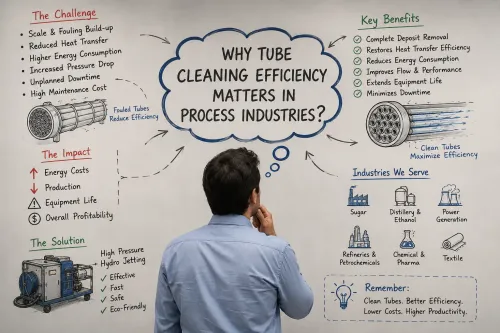
However, refinery environments are extremely harsh. High temperatures, hydrocarbons, scaling compounds, sludge, coke deposits, and fouling materials continuously accumulate inside tubes and shells. Over time, these deposits reduce heat transfer efficiency and create serious operational problems.
Many refineries experience frequent shutdowns, increased energy consumption, pressure drops, and production losses because of dirty heat exchangers. Traditional cleaning methods often fail to completely remove hard deposits, especially in heavily fouled refinery equipment.
This is where Hydro Jetting technology becomes one of the most effective industrial cleaning solutions.
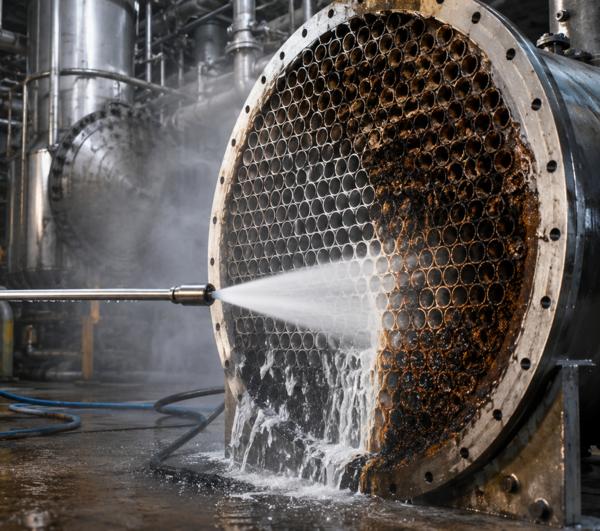
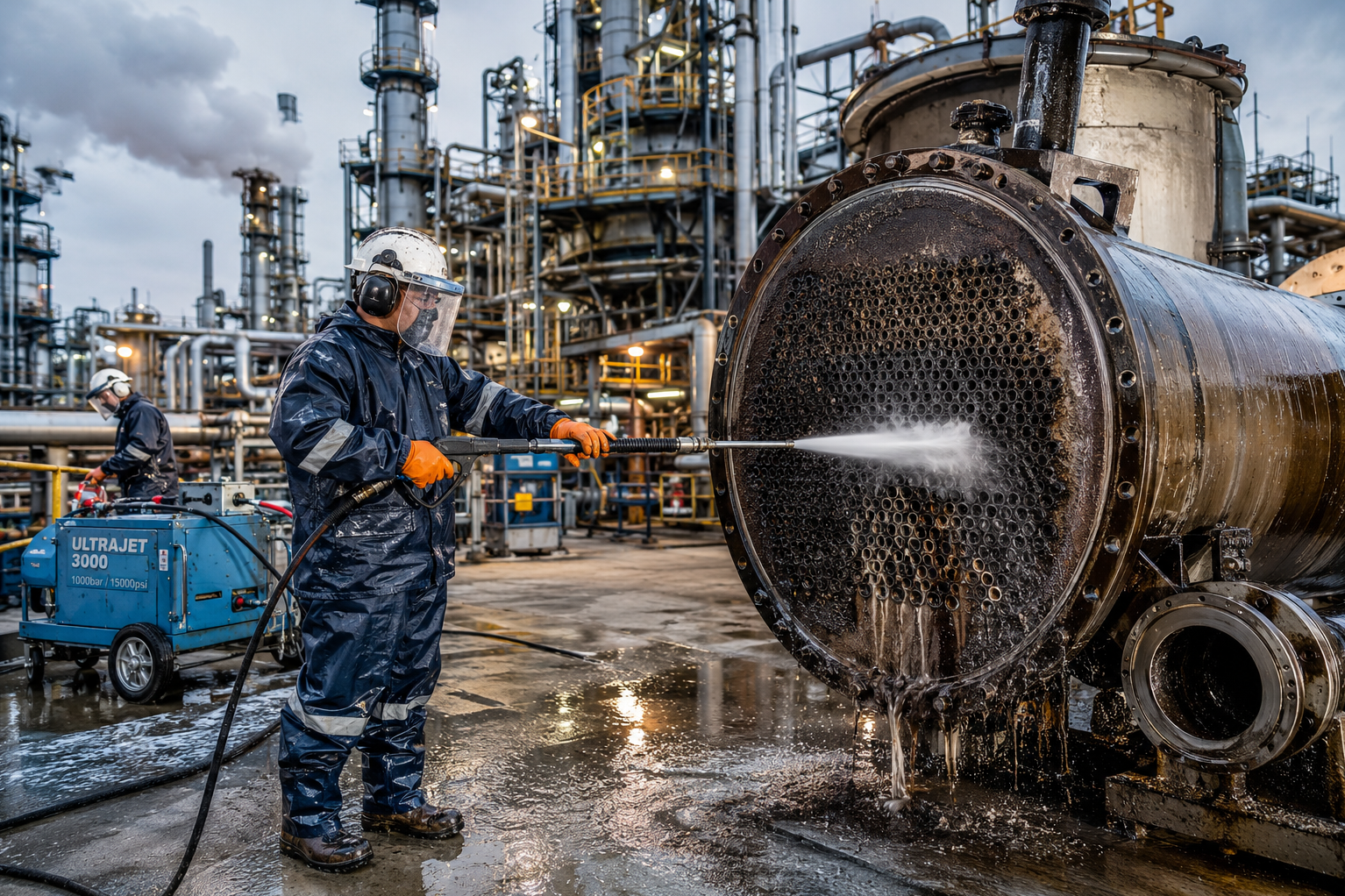
Using high-pressure water jets, hydro jetting machines can clean heat exchanger tubes thoroughly without damaging the equipment, helping refineries improve efficiency, reduce downtime, and extend equipment life.
Common Problems in Refinery Heat Exchangers
1. Fouling and Scale Formation
One of the biggest challenges in refinery heat exchangers is fouling. During refinery operations, impurities, hydrocarbons, salts, sulfur compounds and suspended particles settle inside exchanger tubes.
Common refinery deposits include:
• Hard scale
• Hydrocarbon sludge
• Coke deposits
• Salt scaling
• Biological fouling
As deposits grow thicker, heat transfer efficiency decreases significantly.
Effects of Fouling
• Reduced heat transfer rate
• Increased operating temperature
• Reduced throughput
• Increased maintenance frequency
Even a thin layer of scaling can drastically reduce thermal efficiency and increase energy costs.
2. Tube Blockage
In many refinery processes, exchanger tubes become partially or fully blocked due to accumulated debris and hardened deposits.
Tube blockage leads to:
• Restricted fluid flow
• Uneven temperature distribution
• Reduced production capacity
• Process instability
If not cleaned properly, complete tube choking can force emergency shutdowns.
3. Reduced Heat Transfer Efficiency
Dirty heat exchanger surfaces cannot transfer heat effectively. This reduces the overall thermal performance of the refinery process.
Consequences include:
• Lower process efficiency
• Increased steam consumption
• Higher fuel costs
• Longer heating cycles
• Reduced product quality
Poor heat transfer directly impacts refinery profitability.
4. Frequent Shutdowns and Production Loss
When exchangers become heavily fouled, refineries are forced to shut down units for maintenance.
This results in:
• Production losses
• Increased maintenance costs
• Delayed operations
• Reduced plant availability
Unplanned shutdowns are especially expensive in refinery operations where continuous production is critical.
How Hydro Jetting Machines Solve These Problems
What is Hydro Jetting?
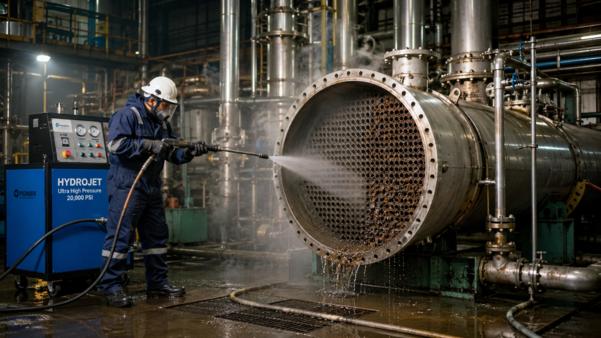
Hydro jetting is a high-pressure water cleaning process that uses high-pressure pumps to remove hard deposits from industrial equipment surfaces.
The system generates powerful water jets capable of removing:
• Scale
• Sludge
• Coke
• Rust
• Hard fouling
without damaging heat exchanger tubes.
Hydro jetting systems commonly operate from at 20, 000 PSI depending on the refinery application.
Benefits of Hydro Jetting in Refinery Heat Exchanger Cleaning
1. Complete Removal of Hard Deposits
Hydro jetting can remove even the toughest refinery fouling materials including:
• Coke build-up
• Hydrocarbon sludge
• Salt deposits
• Hard scale
• Carbon deposits
Unlike manual cleaning, high-pressure water reaches deep inside tubes and ensures thorough cleaning.
2. Restores Heat Transfer Efficiency
After hydro jetting, exchanger surfaces become clean and smooth, allowing proper heat transfer.
Benefits include:
• Improved thermal efficiency
• Reduced fuel consumption
• Better process performance
• Lower energy costs
• Faster heat exchange
This directly improves refinery productivity.
Applications of Hydro Jetting in Refineries
Hydro jetting is widely used in refinery equipment such as:
• Shell & tube heat exchangers
• Condensers
• Reboilers
• Process coolers
• Boilers
• Evaporators
• Piping systems
• Reactor cleaning
• Tank cleaning
It is especially effective during refinery shutdown maintenance activities.
Conclusion
Heat exchanger fouling is one of the most common and costly problems in refinery operations. Scale, sludge, coke, and other deposits reduce heat transfer efficiency, increase pressure drop, raise energy costs, and cause unplanned shutdowns.
Hydro jetting machines provide a highly effective solution for cleaning refinery heat exchangers. With ultra-high-pressure water jets, they remove hard deposits quickly, safely, and efficiently while restoring exchanger performance and minimizing downtime.
As refineries continue focusing on operational efficiency, energy savings, and preventive maintenance, hydro jetting has become an essential technology for industrial heat exchanger cleaning.